
mabl Alternatives in 2026: 7 Tools Compared by How the AI Works
mabl alternatives compared: Katalon, Playwright, Autosana, testRigor, BrowserStack, Cypress and Sauce Labs. Pricing, what each AI actually operates on, and the free options.
Yuvan Sundrani · 16 min read
autosana.ai
TL;DR
- Katalon is the closest like-for-like swap, a low-code platform over Selenium and Appium.
- Playwright skips AI authoring entirely and hands you code-first control at zero licence cost.
- Autosana is the one to look at when the stored test artifact itself is the cost.
- testRigor keeps plain-English authoring without generating framework code.
- BrowserStack closes the device-coverage gap that mabl leaves open.
- Cypress suits JavaScript front-end teams who want time-travel debugging.
- Sauce Labs carries the largest device scale and the compliance paperwork with it.
mabl calls itself an agentic testing platform, and the claim is fair as far as it goes. Its pricing page describes one purchase covering web, mobile, API, accessibility and performance testing, and names Mercedes-Benz, LendingClub Bank and JetBlue among its customers.
The platform is strong. Teams leave for structural reasons rather than quality ones.
The axis that sorts the alternatives is one most comparison pages skip: what the AI actually operates on. Some tools point the agent at the test. One points it at the app. Two skip AI authoring and give you code.
Why move off mabl?
Pricing is the first reason, and the obstacle is sizing rather than scale. mabl's own pricing page leads with Request a Quote and publishes no tiers, so you cannot model the cost yourself before talking to someone. What it does commit to is generous: unlimited test run concurrency, unlimited local and CI runs, and unlimited apps, environments and workspaces, with credits mentioned in the FAQ rather than quantified.
The second is the authoring surface. mabl's Trainer records tests locally in a desktop app before pushing them up, which sits awkwardly beside a team already opening pull requests through Cursor or Claude Code. The broader preference is visible: a r/QualityAssurance thread asking why most engineers pick Playwright, Selenium or Cypress over codeless tools like Testim, Mabl and TestSigma drew 37 votes and 46 comments of fairly direct answers.
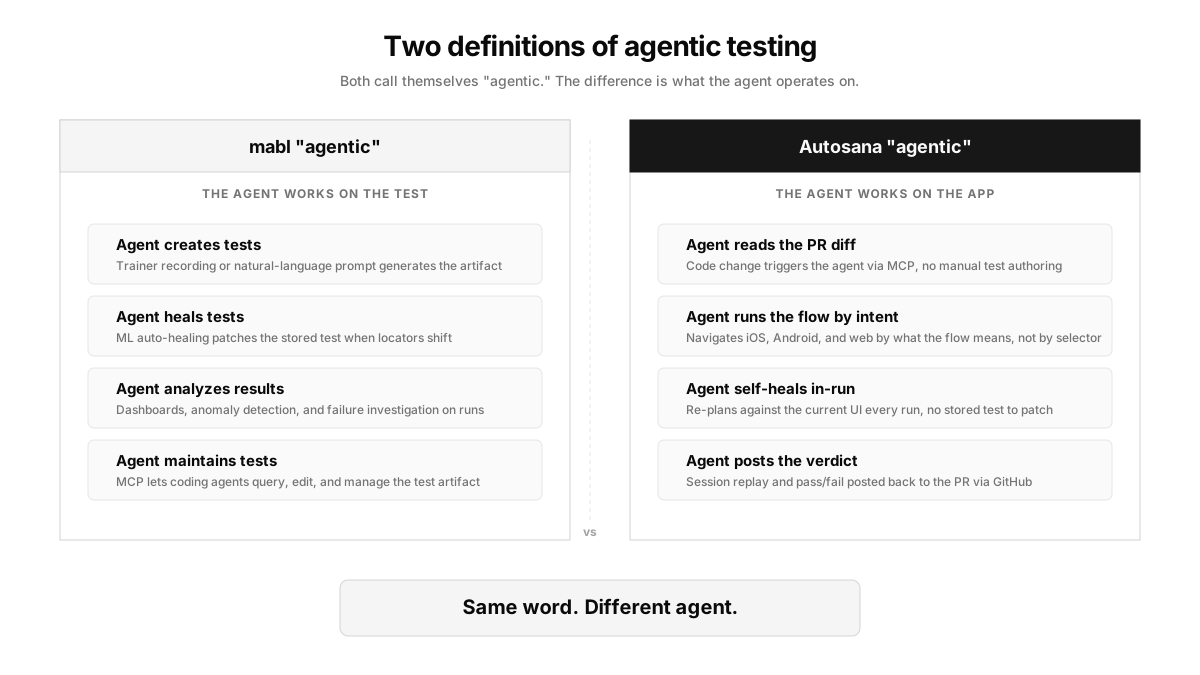
The third is the word agentic itself. mabl's agents create, run, analyse and maintain tests, so every verb takes the same object: the stored test. Your team still owns that artifact and approves its heal patches. Scepticism about vendor framing is healthy here, and a r/softwaretesting post satirising automation vendor claims sits at 204 votes.
Here is the reframe worth holding onto: two tools can both be agentic and still point the agent at completely different things.
| Tool | What It Tests | Pricing | Best For |
|---|---|---|---|
| Katalon | Web, mobile, API, Windows desktop | Free tier, Professional $1,000/seat/yr | Mixed-skill teams on Selenium and Appium |
| Playwright | Web (Chromium, Firefox, WebKit) | Free, Apache 2.0 | Code-first teams leaving low-code behind |
| Autosana | Native iOS and Android, plus web | Per agent-run, self-serve trial | Teams removing the test artifact entirely |
| testRigor | Web, mobile and API | Per-run, free trial | Non-technical authors writing plain English |
| BrowserStack | Web and mobile, 3,500+ real devices | Contact sales, free trial | Closing the device-coverage gap |
| Cypress | Web (Chromium-based, Firefox) | Free runner, Cloud paid | JavaScript teams who debug in the browser |
| Sauce Labs | Web and mobile, 10,000+ devices | Contact sales, free trial | Regulated industries at device scale |
1. Is Katalon a good mabl alternative?
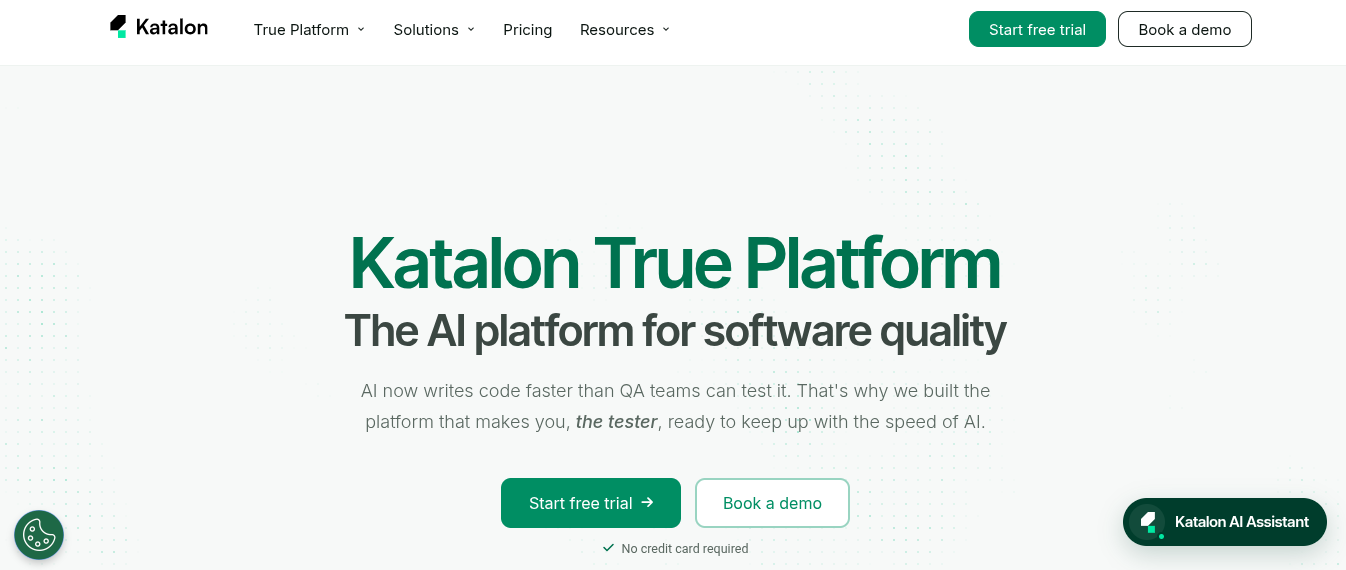
Katalon Studio is a Java-based desktop IDE built on Selenium for web and Appium for mobile. You author by recording, by keyword library or by Groovy script, StudioAssist layers AI onto the authoring, and TestOps and TestCloud cover reporting and hosted execution. For a team leaving mabl but keeping a low-code surface, this is the nearest shape.
What it inherits is Selenium's failure mode. The engine underneath is still WebDriver, so selector fragility on refactors arrives exactly as it always did, now behind a friendlier wrapper. A r/QualityAssurance thread collecting low-code framework suggestions is a useful read on where teams land after trying several.
Pros: bundled Selenium and Appium engines, GUI recorder and Object Spy, coverage across web, mobile, API and Windows desktop, and a free Studio tier.
Cons: selector-based underneath, the free tier excludes parallel execution, and the iOS Object Spy has known compatibility gaps across Xcode versions.
Pricing: a free tier plus a 30-day free trial with no card, and the Professional plan listed at $1,000 per seat per year on Katalon's pricing page as a first-purchase offer against a $2,199 regular rate. Enterprise is an annual contract.
Best for: mixed-skill QA teams with existing Selenium and Appium investments.
2. Can Playwright replace mabl for web testing?
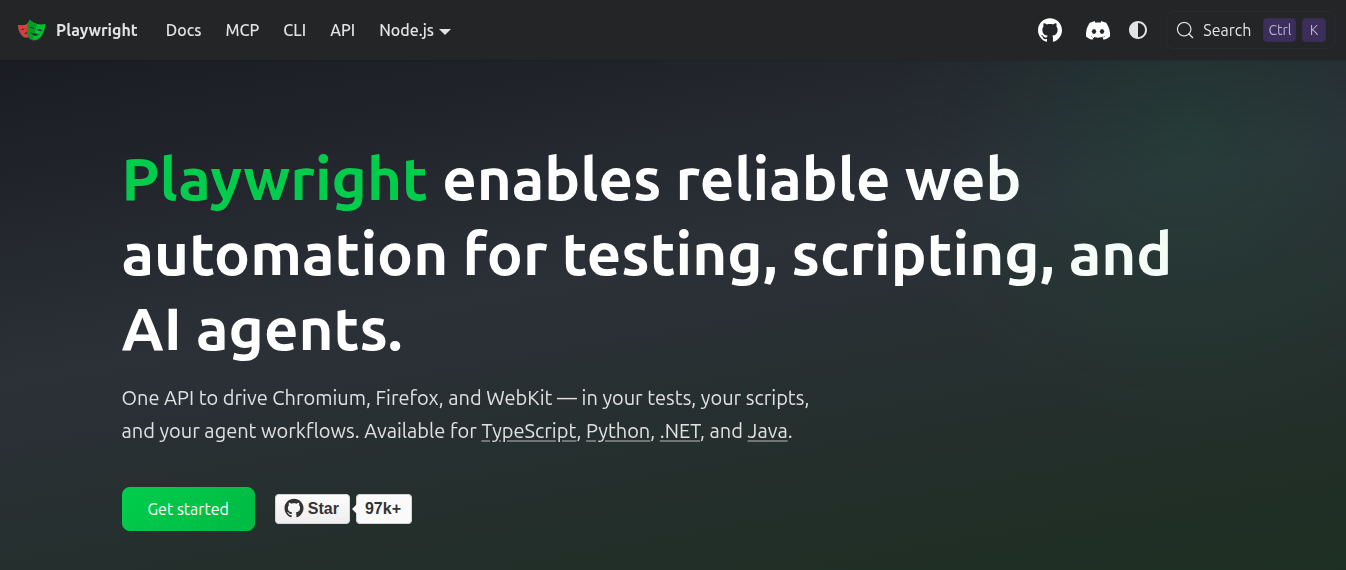
Playwright is Microsoft's open-source framework. It drives Chromium, Firefox and WebKit through one API with auto-waiting, network interception and native parallelism, across JavaScript, TypeScript, Python, Java and C#. There is no AI authoring layer beyond the codegen recorder, which is the point for teams who concluded the AI was the problem rather than the solution.
The objection to code-first is usually that non-technical testers cannot use it, and that deserves a real counterexample rather than a dismissal. A r/Playwright post from someone who entered QA from a non-technical background specifically through Playwright drew 49 votes and 27 comments, and the thread is a practical account of how long that ramp actually takes.
Pros: free, genuinely cross-browser, five language bindings, auto-waiting removes a class of flake, and trace viewer gives you a debugging surface without a paid dashboard.
Cons: selector-based, so a renamed element still breaks the test. Viewport emulation rather than real devices, and the CI infrastructure becomes yours to run.
Pricing: free, Apache 2.0.
Best for: teams treating the move off low-code as a deliberate upgrade.
3. Is Autosana a mabl alternative with no test artifact?
Here is the honest pivot. If your mabl problem is the licence line or the device matrix, Katalon and BrowserStack address those more directly and you should take one of them. A different group is leaving because maintaining, healing and approving stored tests is the work they want to stop doing, and no amount of better healing removes an artifact that exists.
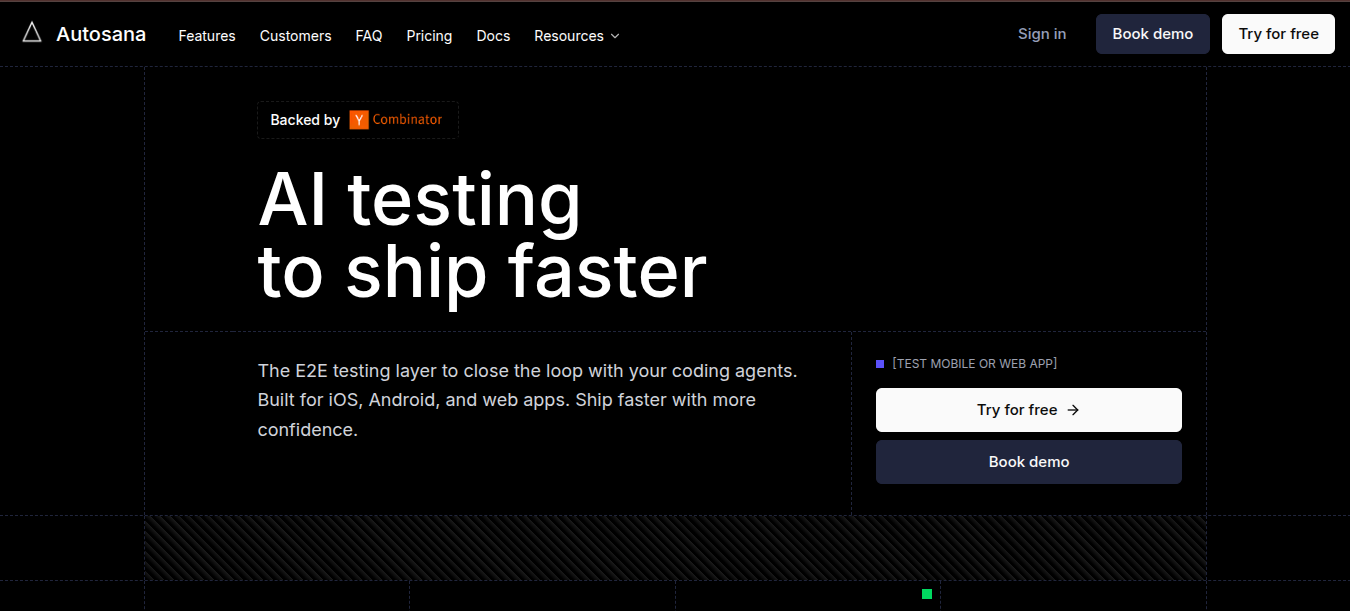
Autosana is a cloud-hosted AI agent that tests an app the way a person would. You describe a flow in natural language or hand the agent a code diff, and nothing is stored between the intent and the execution. When the UI changes, the agent re-anchors to whatever element matches the intent at runtime.
The integration surface is where the verb-object distinction becomes concrete. mabl's MCP server connects coding agents to the test artifact so they can query results, investigate failures and edit tests. On the Autosana side the work is split across two documented surfaces: the MCP server connects Claude Code, Cursor, Codex, Devin and Gemini CLI for flow management and running flows from the IDE, while the GitHub Bot analyses a pull request, runs the relevant flows and posts the results with video. The flows themselves cover iOS and Android builds and web on virtual and physical devices.
Whether this works in practice is a live question rather than a settled one, and a r/QualityAssurance thread asking whether anyone has successfully shipped AI-written E2E tests carries 33 votes and 79 comments worth reading before you commit either way.
Pros: no stored test to maintain, intent survives UI refactors, one surface for iOS, Android and web, pricing that scales with pull request volume rather than seats or credits, and a self-serve trial.
Cons: sub-100ms pixel-level visual regression belongs to Percy and Applitools, load testing to k6 and Locust, and dedicated accessibility scoring stays with mabl. Offline-only apps with no backend fixture story fit poorly.
Pricing: per agent-run, with a self-serve trial and no credit allowance.
Best for: teams whose mabl complaint is the artifact rather than the price.
4. Is testRigor a mabl alternative for plain-English authoring?
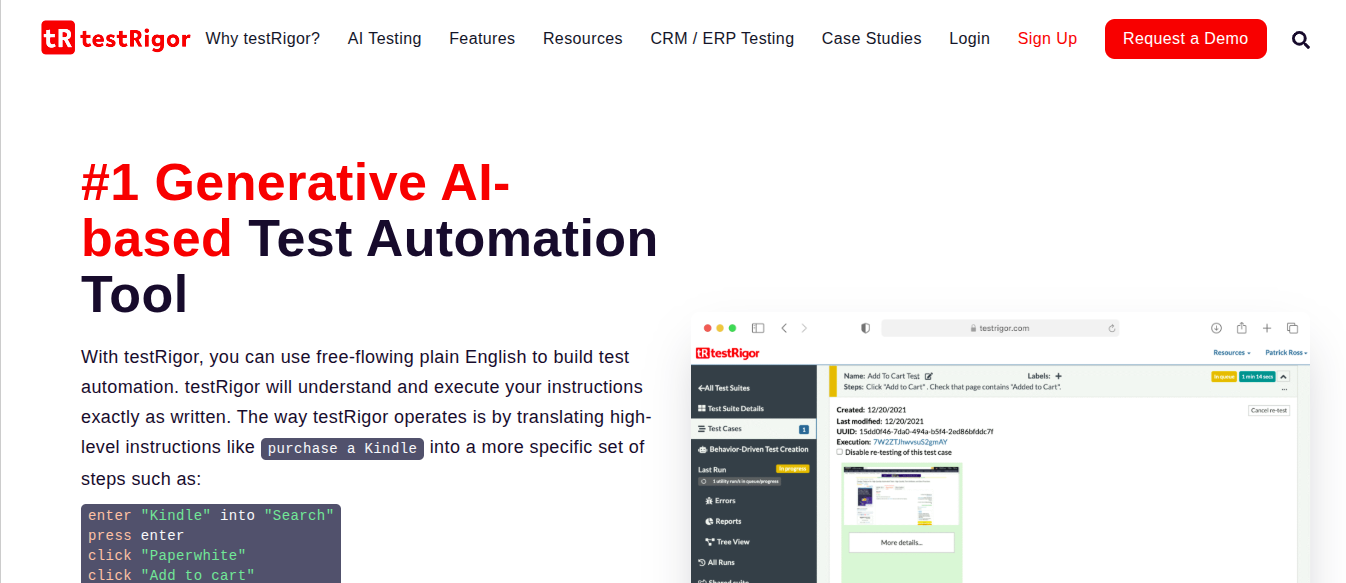
testRigor keeps the thing non-technical authors actually valued about mabl, which is writing a test in a sentence, and drops the generated framework code. Tests live inside testRigor's own runtime, which removes the maintenance-of-generated-code problem and replaces it with platform dependency.
The honest question is whether moving from one proprietary runtime to another counts as progress. Where the team has no engineers and no plan to hire any, it does, since the alternative is coverage nobody can write. Where engineers are available, the calculation flips.
Pros: plain-English authoring with no code output, cross-browser and mobile execution, built-in CI integrations, and email, SMS and API steps inside a single flow.
Cons: tests are tied to a proprietary runtime with no open-source fallback, and the community ecosystem is small next to Selenium or Playwright.
Pricing: per-run, with a free trial.
Best for: QA teams with non-technical authors who want to keep plain-English authoring.
5. Is BrowserStack a mabl alternative for device coverage?
mabl covers browser UI and mobile, and it does not operate a device cloud of its own at the scale a mobile-heavy team needs. BrowserStack does exactly that: 3,000 browser and OS combinations, 3,500 real iOS and Android devices, Automate and App Automate for script execution, Percy for visual regression, and Live for interactive manual sessions.
This solves coverage rather than authoring, so you keep whatever framework you move to and change only where it runs. Our BrowserStack alternatives guide covers the field for teams weighing the device clouds against each other.
Pros: the broadest device and browser matrix, Percy bundled, mature Selenium, Appium, Playwright and Cypress support.
Cons: no authoring agent, so the test-creation problem stays exactly where it was, and plans scale on parallel sessions.
Pricing: contact sales, with a free trial.
Best for: teams whose real gap is device coverage.
6. Can Cypress replace mabl for front-end testing?
Cypress runs inside the browser event loop, which is what gives it a DOM snapshot at every step and the time-travel debugging people stay for. For a JavaScript or TypeScript team moving off a low-code platform, the debugging experience is frequently the thing that makes the migration feel like a gain rather than a tax.
The boundary is worth stating plainly: Cypress tests the web. A team shipping a native iOS or Android app beside the site covers half the surface here and needs a second answer for the rest.
Worth being concrete about what you give up alongside the visual builder: a shared vocabulary with your developers. A Cypress spec is reviewable in a pull request by anyone on the team, which changes who can fix a broken test.
Pros: the best debugging experience in the category, automatic waiting for DOM stability, first-class TypeScript support, and a strong plugin ecosystem.
Cons: JavaScript and TypeScript alone, no native mobile, cross-origin and multi-tab flows stay awkward, and parallel runs need the paid Cloud tier.
Pricing: free runner under MIT, with Cypress Cloud paid.
Best for: front-end teams testing single-page applications.
7. Is Sauce Labs a mabl alternative for regulated teams?
Sauce Labs runs 10,000 real and virtual device combinations and ships AURA, its AI assistant for root-cause analysis and failure classification. FedRAMP authorisation, SSO and on-premises options are the reason it clears security review where other vendors stall.
It implements the W3C WebDriver specification like the rest of the category, so an existing Selenium or Appium suite moves across without a rewrite.
Pros: the largest device scale here, AURA for flake analysis, FedRAMP authorisation, and support across every mainstream framework.
Cons: an enterprise sales cycle with no public self-serve tier, and no authoring agent.
Pricing: contact sales, with a free trial.
Best for: regulated organisations where compliance picks the vendor.
Which mabl alternative should you choose?
The decision maps to where your team's time actually goes.
- "We spend most of our time writing and healing tests" and you want AI to do that faster on a stored artifact: Katalon, testRigor, or stay with mabl.
- "We spend most of our time writing and healing tests" and you want to eliminate the artifact entirely: Autosana. The agent runs by intent, no test to heal.
- "We want full code-level control and zero vendor lock-in" on test authoring: Playwright across five languages, or Cypress for JavaScript teams who want time-travel debugging.
- "Our bottleneck is device and browser coverage, not authoring": BrowserStack with Percy bundled, or Sauce Labs at 10,000 combinations with AURA. Our mobile testing tools roundup compares the wider field.
- "We run coding agents and need tests that close the loop on PRs": Autosana's GitHub Bot analyses the pull request, runs the relevant flows and posts results with video. mabl's MCP helps the coding agent author and manage the test artifact instead. Different loop, different value.
If your team ships weekly and already runs coding agents, the question stops being which tool writes tests faster. It becomes whether you need a test artifact at all. mabl answers yes, Autosana answers no, and both answers are legitimate.
Conclusion
mabl rarely loses on capability. It loses on shape, since contact-sales pricing with a credit allowance suits a buying cycle that many teams have left behind, and the Trainer desktop recorder sits oddly next to a pull request opened by a coding agent.
Before you shop, settle one question: is the cost the licence, the device coverage, or the stored test itself. Each points somewhere different, and only the third one calls for a structural change rather than a cheaper vendor.
Frequently asked questions
Is mabl free in 2026?
A free trial is offered on the mabl site. Beyond it, the pricing page leads with Request a Quote and publishes no tiers, so the figure comes from a sales conversation. What the page does commit to is unlimited test run concurrency, unlimited local and CI runs, and unlimited apps, environments and workspaces.
What is the best free alternative to mabl?
Playwright. Free under Apache 2.0, cross-browser (Chromium + Firefox + WebKit), five-language support, auto-waiting, and the largest modern testing community outside Selenium. No license cost, no credit limits, no contact-sales friction. The tradeoff is that you own all test authoring and maintenance yourself.
Can Autosana replace mabl for web and mobile testing?
For UI-driven web and mobile flows, yes. Autosana runs iOS, Android, and web by intent with no stored test artifact and no credit-based pricing. For dedicated accessibility scoring, performance benchmarking, and AI application testing, mabl covers scope Autosana does not target. If 60%+ of your mabl suite is UI flows, Autosana replaces it.
Does mabl support native mobile app testing?
Yes. Mobile app testing is one of six products under the mabl platform, covering iOS and Android via the Trainer authoring surface and cloud execution. Mobile runs consume the same cloud credits as browser tests. Coverage depth is narrower than dedicated mobile testing tools.
What does agentic testing mean in mabl compared to Autosana?
In mabl, agents autonomously create, run, analyze, and maintain tests. Every verb's object is the test artifact. In Autosana, the agent reads the PR diff, runs the flow by intent, self-heals in-run, and posts the verdict. Every verb's object is the app. Same word, different subject.It scales with suite size and with how much of the suite still earns its keep, so scope it against your own flow count rather than a published average. The usual shape is parallel running first, critical flows next, regression after that.ai/mcp-setup) documents setup for Claude Code, Cursor, Codex, Devin, Gemini CLI and Hermes Agent, and the GitHub Bot handles the pull request loop by analysing the PR, running the relevant flows and posting results with video. mabl's MCP server points its coding agents at the test artifact instead.
How long does migrating off mabl take?
It scales with suite size and with how much of the suite still earns its keep, so scope it against your own flow count rather than a published average. The usual shape is parallel running first, critical flows next, regression after that.
Which mabl alternative works best with coding agents?
Autosana's MCP server documents setup for Claude Code, Cursor, Codex, Gemini CLI, Devin and Hermes Agent, and the GitHub Bot analyses a pull request, runs the relevant flows and returns results with video. mabl ships its own MCP server pointed at its test artifact.
Where does Autosana not fit as a mabl replacement?
Dedicated accessibility scoring, performance benchmarking, API-only suites, AI application testing such as LLM output validation, and offline-only apps with no backend fixture story. For these scopes, mabl or specialized tools (axe for accessibility, k6 for load, Postman for API) remain the better answer.