
8 Testsigma Alternatives in 2026, Compared by Authoring Model and Deployment
Testsigma alternatives compared: Playwright, Katalon, Autosana, testRigor, BrowserStack, Cypress, Mabl and Appium. Pricing, lock-in, and the free options.
Yuvan Sundrani · 15 min read
autosana.ai
TL;DR
- Playwright replaces the authoring layer with code, free and across five languages.
- Katalon is the closest low-code swap, with a free Studio tier.
- Autosana is the one to look at when you want natural language with nothing stored.
- testRigor keeps plain-English authoring in a vendor runtime.
- BrowserStack covers the device and browser matrix rather than authoring.
- Cypress suits JavaScript teams who want time-travel debugging.
- Mabl offers low-code authoring with machine-learning healing.
- Appium is the free, standards-based route for mobile.
Testsigma describes itself on its own site as a unified agentic test automation platform, with AI agents that create automated tests for web, mobile, API and Salesforce, then run and self-heal them as the application evolves.
The pricing page backs that breadth with 3,000 browsers and devices on the cloud, 50 GB of cloud storage per parallel run, and a choice of public, private or on-premises deployment.
On paper that covers almost everything. The question practitioners raise is how much of it works the way the page implies.
Why move off Testsigma?
Maturity is the complaint that comes up first. In a r/QualityAssurance thread on paid tooling, at 16 votes and 39 comments, a tester whose company had recently adopted it put it plainly: these tools are not mature enough, and once you start using them you find features that fail to work as expected. That is one voice rather than a verdict, and it is the kind of thing worth probing hard during a trial.
The second is the wider scepticism about codeless platforms. A r/QualityAssurance thread asking why most engineers choose Playwright, Selenium or Cypress over codeless tools, naming Testsigma among them, drew 37 votes and 46 comments, and the answers circle the same themes: control, debuggability and what happens when the abstraction leaks.
The third is lock-in, which follows directly from the first two. Tests authored inside a proprietary surface stay there, so the exit cost grows with every test you add. A r/QualityAssurance discussion of no-code tooling, at 45 comments, keeps returning to that trade.
Here is the reframe worth holding onto: a platform that covers five surfaces is only a saving where all five actually work for you.
| Tool | What it tests | Pricing | Best for |
|---|---|---|---|
| Playwright | Web (Chromium, Firefox, WebKit) | Free, Apache 2.0 | Replacing authoring with code |
| Katalon | Web, mobile, API, Windows desktop | Free tier, Professional $1,000/seat/yr | The closest low-code swap |
| Autosana | iOS, Android and web | Per agent-run, self-serve trial | Natural language with nothing stored |
| testRigor | Web, mobile and API | Published tiers | Plain-English authoring |
| BrowserStack | Web and mobile, 3,500+ real devices | From $29/mo | Device and browser coverage |
| Cypress | Web (Chromium-based, Firefox) | Free runner, Cloud paid | Front-end debugging |
| Mabl | Web, mobile, API, accessibility, performance | Request a quote | Low-code with ML healing |
| Appium | Native iOS and Android | Free, Apache 2.0 | Standards-based mobile execution |
1. Can Playwright replace Testsigma for web testing?
For the web surface, yes, and it answers the lock-in objection directly, because the tests are files in your repository. Playwright drives Chromium, Firefox and WebKit through one API with auto-waiting, network interception and native parallelism, across JavaScript, TypeScript, Python, Java and C#.
Migration is less daunting than it was. A r/Playwright post on using AI to move a thousand tests off Selenium in about an hour shows how much of the mechanical conversion work is now automatable.
Auto-waiting is the quality-of-life difference worth naming. Playwright waits for an element to become actionable rather than merely present, which removes the arbitrary sleeps that accumulate in recorded suites and takes a large share of intermittent failures with them.
Pairing is the normal outcome rather than a compromise. Playwright for web, Appium or a device cloud for mobile, and a dedicated API tool alongside, which costs more tools and usually less money than one platform covering all three unevenly.
Pros: free, cross-browser, five language bindings, tests live in your repository, trace viewer debugs CI failures without a dashboard licence. Cons: web only, so mobile, API and Salesforce coverage needs separate answers, and someone has to write code.
Pricing: free, Apache 2.0.
Best for: teams treating the move off low-code as a deliberate upgrade.
2. Is Katalon a good Testsigma alternative?
Katalon is the nearest like-for-like: a low-code IDE with a GUI recorder, Object Spy and Groovy scripting, running Selenium and Appium underneath, covering web, mobile, API and Windows desktop.
Its free Studio tier is the practical difference. You can evaluate it properly over a sprint without a quote, which lets you test the maturity question for yourself rather than taking anyone's word for it.
Object Spy and the recorder together give a non-coder a genuine on-ramp, and Groovy sits underneath for the moment a test outgrows the GUI. That escape hatch is the structural answer to a pure no-code platform.
Pros: free Studio tier, four surfaces covered, bundled Selenium and Appium, GUI recorder for non-coders.
Cons: selector-based underneath, the free tier excludes parallel execution, and scripting is Groovy only.
Pricing: a free tier plus a 30-day free trial with no card, and the Professional plan listed at $1,000 per seat per year on Katalon's pricing page as a first-purchase offer against a $2,199 regular rate. Enterprise is an annual contract.
Best for: mixed-skill teams who want the same shape with a free entry point.
3. Is Autosana a Testsigma alternative with no stored tests?
Here is the honest pivot. If you need Salesforce, API and desktop coverage under one contract, Katalon or staying put serves that better than anything here. A different group adopted an agentic platform to stop maintaining tests and found they were maintaining a proprietary artifact instead.
Autosana writes flows in natural language and runs them against the current interface. Nothing is generated and nothing is stored, so the lock-in question changes shape: there is no proprietary test file to export because there is no test file. Coverage spans apps on virtual and physical iOS and Android devices and web across Chrome, Firefox, Edge and Chromium.
Two documented integration surfaces are worth keeping apart. The MCP server connects Claude Code, Cursor, Codex, Gemini CLI, Devin and Hermes Agent for flow management and running flows from the IDE. The GitHub Bot handles the pull request loop, analysing the PR, running the relevant flows and returning results with video. The docs also cover performance monitoring and network traffic inspection during a run, and code-managed flows for teams who want flow definitions living in their own repository.
Scepticism about AI authoring is healthy and worth bringing to any trial. A r/softwaretesting thread titled "AI is a nightmare for QA" carries 174 votes and 108 comments of it.
Pros: no proprietary test artifact, flow definitions can live in your own repository, mobile and web in one surface, per-run pricing, and a self-serve trial.
Cons: no Salesforce, API or desktop application testing, so a team using Testsigma for those keeps a tool for them.
Pricing: per agent-run, self-serve.
Best for: teams whose objection is the artifact rather than the price.
4. Is testRigor a Testsigma alternative for plain-English authoring?
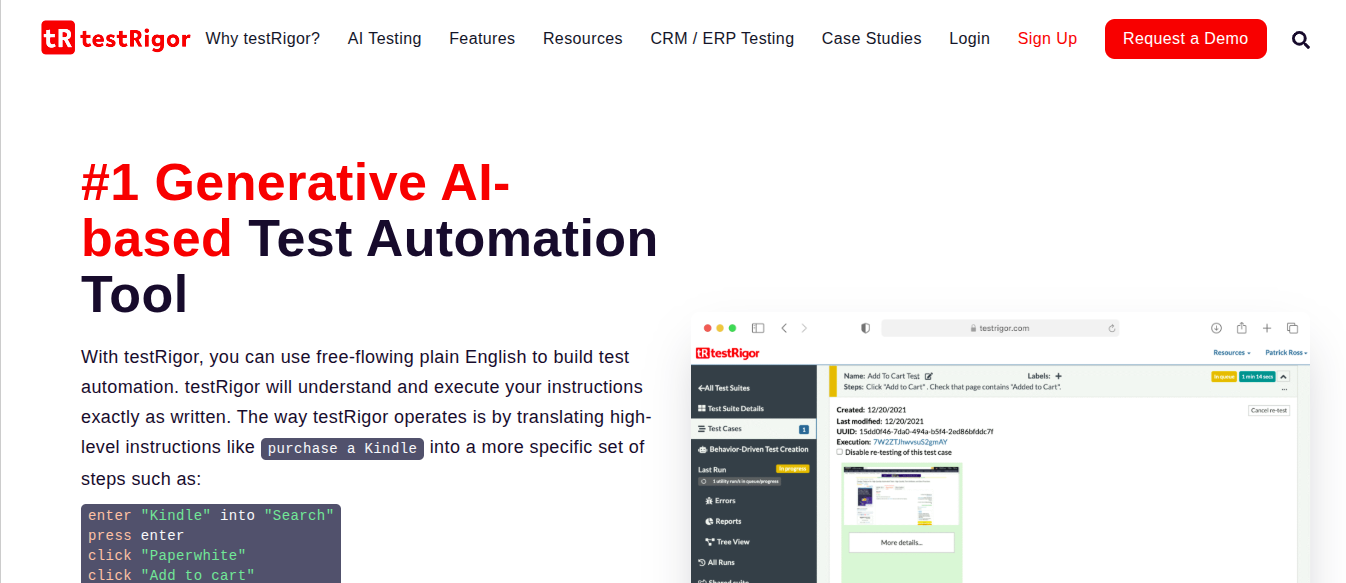
testRigor serves the same audience and narrows the scope honestly, taking plain English sentences across web, mobile and API, with email, SMS and API steps inside a single flow.
The lock-in objection applies here as squarely as it does to Testsigma, since tests run where testRigor runs. Where a QA function has no engineers and no plan to hire them, that trade is reasonable. Where engineers exist, a code-first framework reaches further for nothing.
Email, SMS and API steps inside a single flow are the practical draw, since login and one-time-code paths are exactly where a codeless tool usually forces a custom workaround.
Pros: plain-English authoring with no code, web, mobile and API in one flow, built-in CI integrations.
Cons: proprietary runtime with no open-source fallback, and a small ecosystem next to Selenium or Playwright.
Pricing: published tiers.
Best for: non-technical authors who want the authoring style without the platform breadth.
5. Is BrowserStack a Testsigma alternative for device coverage?
Where the gap is browsers and handsets rather than authoring, BrowserStack addresses it directly with 3,500 real devices, Automate and App Automate for script execution, Percy for visual regression, and Live for interactive sessions.
You keep whichever framework you move to and change only where it runs, which pairs naturally with Playwright or Appium. Our BrowserStack alternatives guide compares the clouds.
Percy and Observability sit alongside, covering visual regression and flaky test detection, so part of what a consolidated platform promised arrives here as separate products you can adopt one at a time.
Pros: the broadest device and browser matrix, published pricing, mature support for every mainstream framework.
Cons: no authoring layer at all, so the agentic promise is not replaced here.
Pricing: from $29 a month, scaling with concurrency.
Best for: teams whose constraint is coverage.
6. Can Cypress replace Testsigma for front-end testing?
Cypress runs inside the browser event loop, producing a DOM snapshot at every step and the time-travel debugging that turns a failing assertion into a quick diagnosis. For a JavaScript team leaving a low-code platform, that loop is usually what makes the move feel like a gain.
The boundary is sharp and worth stating. Cypress tests the web in JavaScript, so a team using Testsigma for Salesforce or mobile covers a fraction of its scope here and needs a second answer for the rest.
Pros: the best debugging experience in the category, automatic waiting for DOM stability, first-class TypeScript support, strong plugin ecosystem.
Cons: JavaScript and TypeScript alone, no native mobile or Salesforce, and parallel runs need the paid Cloud tier.
Pricing: free runner under MIT, with Cypress Cloud paid.
Best for: front-end teams testing single-page applications.
7. Is Mabl a low-code Testsigma alternative?
Mabl covers comparable ground. Its own pricing page describes one purchase spanning web, mobile, API, accessibility and performance testing, with unlimited test run concurrency and unlimited local and CI runs, and leads with Request a Quote rather than published tiers.
Element identification works on behavioural properties rather than literal selectors, so cosmetic change often passes without a break. Structural refactors still break things, because the healing is heuristic.
For a team leaving Testsigma over lock-in, note that this swaps one proprietary authoring surface for another. It answers the maturity complaint rather than the ownership one.
Pros: visual builder for non-technical authors, ML-based selector healing, unlimited concurrency and local runs per its pricing page, breadth across five surfaces.
Cons: quoted pricing rather than published tiers, closed-source, and healing works better on cosmetic shifts than structural ones.
Pricing: request a quote.
Best for: enterprise QA orgs wanting low-code with healing.
8. Is Appium a free Testsigma alternative for mobile?
For the mobile half, Appium removes both the licence and the lock-in. It implements the W3C WebDriver specification, works in five languages, and runs on any device cloud or on your own hardware, so nothing about your tests is tied to a vendor.
What you take on is the infrastructure: device provisioning, driver rebuilds after iOS releases, and flake management. Our Appium guide covers the setup path.
Portability is the underrated part. Because every major device cloud runs Appium natively, the same suite executes on a laptop, on BrowserStack, or on your own rack without modification, which is the opposite of a platform-held test.
Pros: free, language-agnostic, standards-based, portable across every device cloud.
Cons: verbose configuration, iOS driver maintenance, and no web, API or Salesforce coverage.
Pricing: free, Apache 2.0.
Best for: teams who want mobile execution with no vendor tie.
Which Testsigma promise are you replacing?
Agentic authoring. Autosana if you want natural language with no artifact, Mabl or testRigor if a vendor-held test is acceptable. The distinction matters more over time than it does on day one.
Low-code for non-engineers. Katalon, which has a free tier you can evaluate without a quote, and a Groovy escape hatch for the tests that outgrow the recorder.
Breadth across web, mobile, API and Salesforce. This is the hardest to replace piecemeal. Katalon covers four surfaces and Mabl covers five, and most combinations here cover two or three.
Cloud device coverage. BrowserStack, keeping whatever framework you land on, which also makes the next migration cheaper because the tests travel with you.
On-premises or private deployment. Testsigma's pricing page offers public, private and on-premises options, and among the alternatives here Katalon and a self-run Appium grid are the realistic equivalents.
Escaping lock-in. Playwright or Appium. Both put the tests in your repository under an open protocol, which is the only durable answer to the question.
Conclusion
Testsigma promises a lot on one page: agentic authoring, five surfaces, 3,000 devices and a choice of deployment models. Where all of that holds for your stack, consolidating onto it is a genuine saving.
The complaints worth taking seriously are about maturity and lock-in rather than scope. Both are testable during a trial, so run your hardest flows first and confirm the exit path before the test count grows past the point where leaving costs more than staying. That single check tells you more than any feature comparison will.
Frequently asked questions
What is the best free Testsigma alternative in 2026?
Playwright (Apache 2.0) for web-only code-first teams. Appium (Apache 2.0) for native mobile. Cypress (MIT) for JS/TS frontend teams. All three are fully open source with no usage caps. Katalon's free tier covers web, mobile, API, and desktop but limits parallel execution.
Does Testsigma have a free plan?
Testsigma offers a Community/Open Source Edition for local infrastructure use. Both paid tiers (Pro and Enterprise) are custom-quote only with no published price point or self-serve paid signup on the pricing page.
Can Autosana replace Testsigma for web and mobile testing?
For iOS, Android and web flows run by intent, yes, on virtual and physical devices, with the GitHub Bot running the relevant flows on a pull request and returning results with video. Salesforce, desktop and API-schema workflows sit outside its scope, and Testsigma's own site lists those surfaces.
Is Playwright better than Testsigma for web testing?
Playwright gives full code-first control, cross-browser support, and zero vendor lock-in. Testsigma gives AI-assisted authoring and self-healing for mixed-skill teams. Playwright wins for engineering teams that want to own every test line. Testsigma wins for QA orgs where business analysts author alongside developers.
What is the best Testsigma alternative for mobile app testing?
Appium for raw protocol control in any language. Autosana for intent-based mobile testing on virtual and physical devices. Katalon for mobile through Appium under a GUI recorder. Pick by whether you want maximum control, no authoring, or a visual IDE.
How does Testsigma self-healing compare to Autosana self-healing?
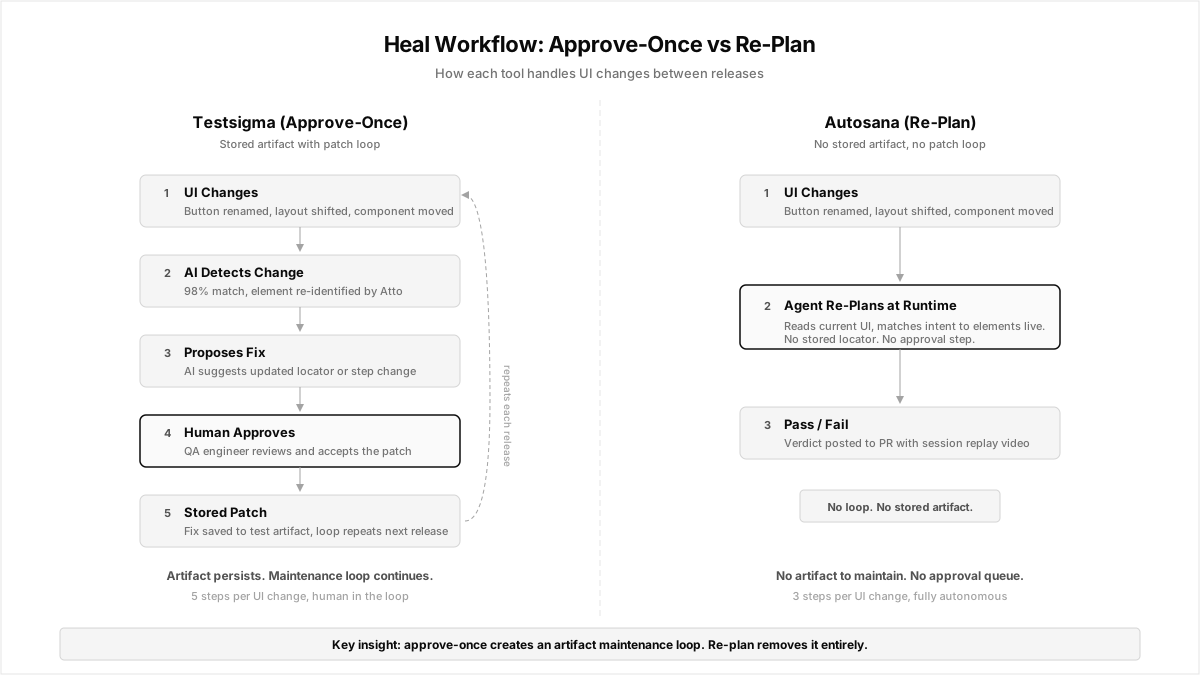
Testsigma's AI detects UI changes and proposes a fix that a human approves once. The patch is stored on the test. Autosana's agent re-plans against the current UI on every run, so there is no stored script to patch and nothing to approve. Different mechanism, different maintenance profile.
Does Testsigma MCP work with coding agents like Cursor and Claude Code?
Testsigma's docs describe AI Agents for generating, optimising and analysing tests, plus a Testsigma Agent for running tests on local machines and devices. On the Autosana side the MCP server documents setup for Claude Code, Cursor, Codex, Gemini CLI, Devin and Hermes Agent, while the GitHub Bot handles the pull request loop.
How long does it take to migrate from Testsigma to a different testing tool?
It scales with suite size and with how much of the suite is still worth keeping, so scope it against your own flow count rather than a published average. The usual shape is parallel running first, critical flows next, regression after that, with Testsigma kept active for any surface the new tool leaves uncovered.