
Waldo Alternatives in 2026: 6 Tools Compared for Mobile App Testing
Waldo alternatives compared: BrowserStack, LambdaTest, Autosana, Kobiton, Playwright and testRigor. What happened to Waldo, pricing, and the free options.
16 min read
autosana.ai
TL;DR
- BrowserStack is the closest swap for the device layer, with published pricing and a free trial.
- LambdaTest covers mobile and web together from the lowest entry price here.
- Autosana is the one to look at when you want codeless authoring without a stored recording.
- Kobiton suits teams who need devices on their own premises.
- Playwright covers the desktop web surface Waldo never offered, free.
- testRigor keeps plain-English authoring for non-technical test authors.
Most people searching for Waldo alternatives are not comparing features. They are trying to work out where the product went.
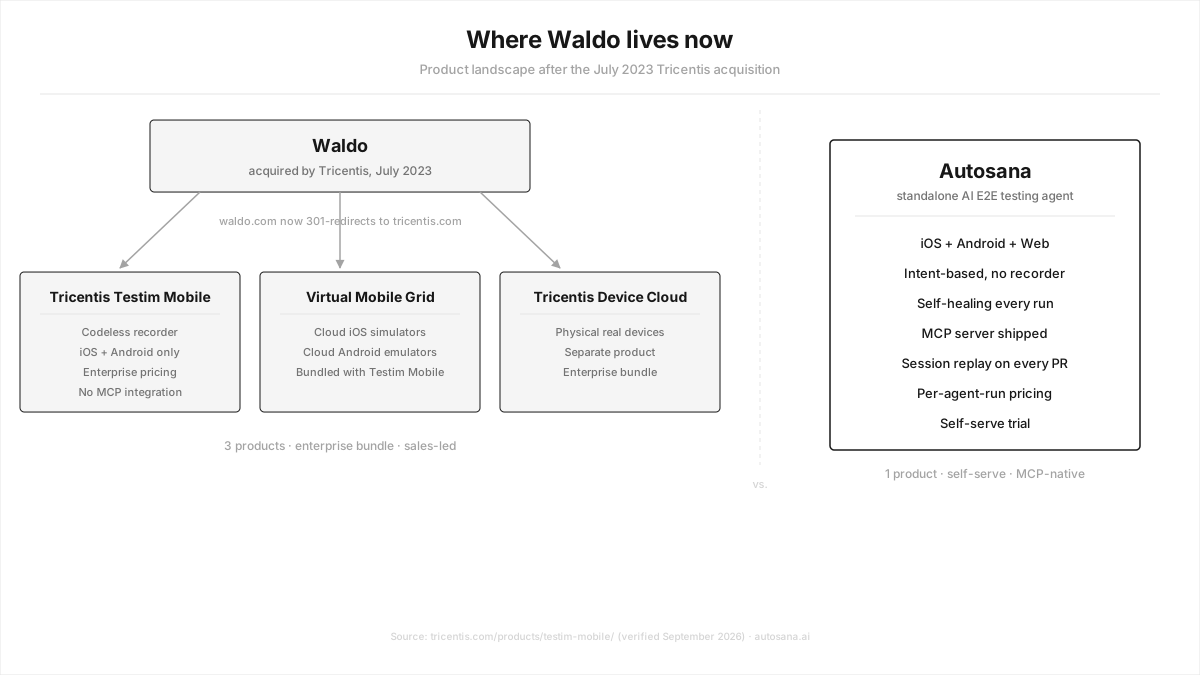
Tricentis acquired Waldo in July 2023. In 2026, waldo.com redirects to the Tricentis homepage rather than to a product page, and the technology now lives as Testim Mobile, which does not appear in the main Tricentis product navigation alongside Tosca, qTest, NeoLoad and SeaLights.
The codeless recorder survived. The standalone product that made it appealing did not.
Why move off Waldo?
The first reason is simply that the thing you evaluated has changed shape. An old bookmark for Waldo's docs or signup now lands on a corporate homepage rather than on the product, and Testim Mobile is absent from the main Tricentis product navigation, which lists Tosca, qTest, NeoLoad and SeaLights. A free trial is still available once you find the page. Finding the page is the problem.
The second is scope. Testim Mobile covers iOS and Android, including hybrid and mobile web, and stops there. A product that grew a web dashboard or an admin panel needs a second tool, a second contract and a second set of results to reconcile before each release.
The third is what codeless recording actually leaves behind. A recorder captures your actions into a stored test, so the authoring is code-free while the maintenance is not: the app moves and the recording needs updating by someone. Whether the category has solved this is contested rather than settled, and a r/QualityAssurance thread asking whether no-code automation tools are good these days drew 45 comments arguing both sides.
Here is the reframe worth holding onto: the recorder survived the acquisition and the standalone product did not, and for most teams the standalone product was the appeal.
| Tool | What It Tests | Pricing | Best For |
|---|---|---|---|
| BrowserStack | Web and mobile, 3,500+ real devices | From $29/mo, free trial | Published pricing and the broadest device matrix |
| LambdaTest | Web and mobile, 10,000+ combinations | Free tier, paid from $15/mo | Both surfaces at the lowest entry price |
| Autosana | iOS, Android and web | Per agent-run, self-serve trial | Codeless authoring with no stored recording |
| Kobiton | Native iOS and Android, 7,000+ devices | Published tiers, on-prem option | Devices inside your own perimeter |
| Playwright | Web (Chromium, Firefox, WebKit) | Free, Apache 2.0 | The desktop web Waldo never covered |
| testRigor | Web, mobile and API | Published tiers | Plain-English authoring without recordings |
1. Is BrowserStack a good Waldo alternative?
BrowserStack restores the thing the acquisition took away, which is a product with its own homepage, its own docs and its own roadmap. Pricing is published and signup is self-serve, so an evaluation starts against your own build rather than against a platform tour.
It carries 3,500 real devices, runs Appium and Espresso through App Automate, covers desktop web through Automate, and offers App Live for interactive manual sessions on real hardware, which is the nearest equivalent to Waldo's recorded exploratory workflow.
Migration effort is modest because App Automate runs standard Appium and Espresso, so a team that already moved off the recorder onto scripts changes a hub URL rather than rewriting. A team still on recordings has authoring work ahead of it whichever option they pick.
App Live is the nearest thing on offer, giving a tester an interactive session on a real handset within seconds, which covers exploratory work well while stopping short of turning that session into a reusable test.
One practical note for teams mid-decision: because the device layer and the authoring layer are separable, you can move device access first and settle the authoring question later, rather than treating the whole thing as one migration.
Pros: published tiers with a free trial, the broadest device matrix, mobile and desktop web in one account, mature CI integrations.
Cons: no codeless recorder of Waldo's kind, so the authoring question stays open, and parallel pricing climbs at scale.
Pricing: from $29 a month, scaling with concurrency.
Best for: teams whose first need is device access on a card.
2. Does LambdaTest cover both mobile and web like Waldo did not?
Yes, and from the lowest floor here. A free tier exists, paid plans start near $15 a month, and the same account spans 10,000 browser and operating system combinations alongside the mobile device cloud. KaneAI adds natural-language authoring across tiers rather than gating it behind an enterprise conversation, which is closer to Waldo's original proposition than anything else on this list.
Depth is the trade. Device inventory and enterprise support both trail the incumbents, which a consumer app team will rarely notice and a regulated buyer will.
The free tier is the part that matters for anyone who liked Waldo's shape. An engineer can run a real flow against a real device before anyone writes a business case, which is exactly the motion the Tricentis acquisition removed.
Pros: free tier, lowest paid entry, mobile and web together, natural-language authoring included.
Cons: thinner enterprise support, smaller device inventory, newest handsets arrive later.
Pricing: free tier, paid from around $15 a month.
Best for: mid-market teams who liked Waldo's self-serve shape.
3. Is Autosana a Waldo alternative without recorded tests?
Here is the honest pivot. If what you need is device access or a bigger matrix, BrowserStack and LambdaTest do that directly and cost less effort to adopt. A different group liked Waldo because nobody had to write code, and then found that a recording is still an artifact somebody maintains.
Autosana writes flows in natural language and runs them against the current interface. Nothing is recorded and nothing is stored, so a redesigned screen needs no re-recording. Coverage spans apps on virtual and physical iOS and Android devices and web across Chrome, Firefox, Edge and Chromium, which closes the desktop web gap in the same tool.
Two documented integration surfaces are worth keeping apart. The MCP server connects Claude Code, Cursor, Codex, Gemini CLI, Devin and Hermes Agent for flow management and running flows from the IDE. The GitHub Bot handles the pull request loop, analysing the PR, running the relevant flows and returning results with video. The docs also cover performance monitoring and network traffic inspection during a run.
Practitioners are still working out where mobile authoring lands. A r/reactnative post announcing a faster testing tool for real iPhones drew 62 votes and 50 comments, and the appetite in that thread is for less ceremony rather than more platform.
Adoption and skill level shape this decision more than feature lists do. A r/QualityAssurance thread weighing real devices against emulators runs 18 votes and 24 comments, and the split in it maps closely onto who has engineering support and who does not.
Pros: no recording to re-capture, mobile and desktop web in one surface, per-run pricing with a self-serve trial, documented MCP clients.
Cons: no on-premises deployment, and dedicated accessibility scoring or load testing sit outside its scope.
Pricing: per agent-run, self-serve.
Best for: teams who wanted codeless and got a maintenance queue.
4. Is Kobiton a Waldo alternative for private device labs?
Where the blocker is data residency rather than authoring, Kobiton is the specific answer. It runs 7,000 devices with cloud, on-premises and BYOD deployment, which is what finance, healthcare and government teams need when builds and test data cannot leave the network.
Session capture converts a manual run into a replayable Appium script, which is the closest structural match to Waldo's recorder, with the same caveat attached: the output is a script you then own.
BYOD management is the quieter draw here. A team can enrol handsets it already owns into the same dashboard as the hosted fleet, keeping a certification device under direct control while routine runs happen in the cloud.
For a team arriving from Waldo, the honest note is that this is a heavier platform than the one you left. It earns that weight only when the device location is a hard requirement rather than a preference.
Worth checking the minute model against your own regression plan before signing, since a budget measured in device minutes tends to shape which devices get exercised rather than which ones should be.
Pros: on-premises and BYOD device labs, 7,000 devices, scriptless capture, device-level logs.
Cons: mobile only, so the web gap remains, and minute-based pricing shapes how much you actually run.
Pricing: published tiers, with an on-premises option.
Best for: regulated teams with devices inside their perimeter.
5. Can Playwright cover the web testing Waldo skipped?
Yes, for nothing. Waldo and Testim Mobile stop at mobile, so most teams running either already pay for something on the web side. Playwright drives Chromium, Firefox and WebKit through one API with auto-waiting, network interception and native parallelism, across five languages, in whatever CI you already run.
The honest limit is that this is code, which is the opposite of why anyone picked Waldo. It belongs here as the free way to close the web half rather than as a replacement for the recorder.
Pairing rather than choosing is the usual pattern. Playwright takes the browser matrix for nothing, a device cloud supplies the handsets, and the combined cost generally lands under a single platform licence that covers both surfaces poorly.
Auto-waiting is the detail that makes the code worth writing. Playwright waits for an element to become actionable rather than merely present, which removes most of the arbitrary delays a recorded test accumulates, and trace viewer returns a DOM snapshot for every step of a failed run.
Pros: free, cross-browser, five language bindings, auto-waiting removes a class of flake, trace viewer debugs CI failures without a dashboard licence.
Cons: desktop web only, viewport emulation rather than handsets, and it needs someone who writes code.
Pricing: free, Apache 2.0.
Best for: closing the web gap without another subscription.
6. Is testRigor a Waldo alternative for non-technical testers?
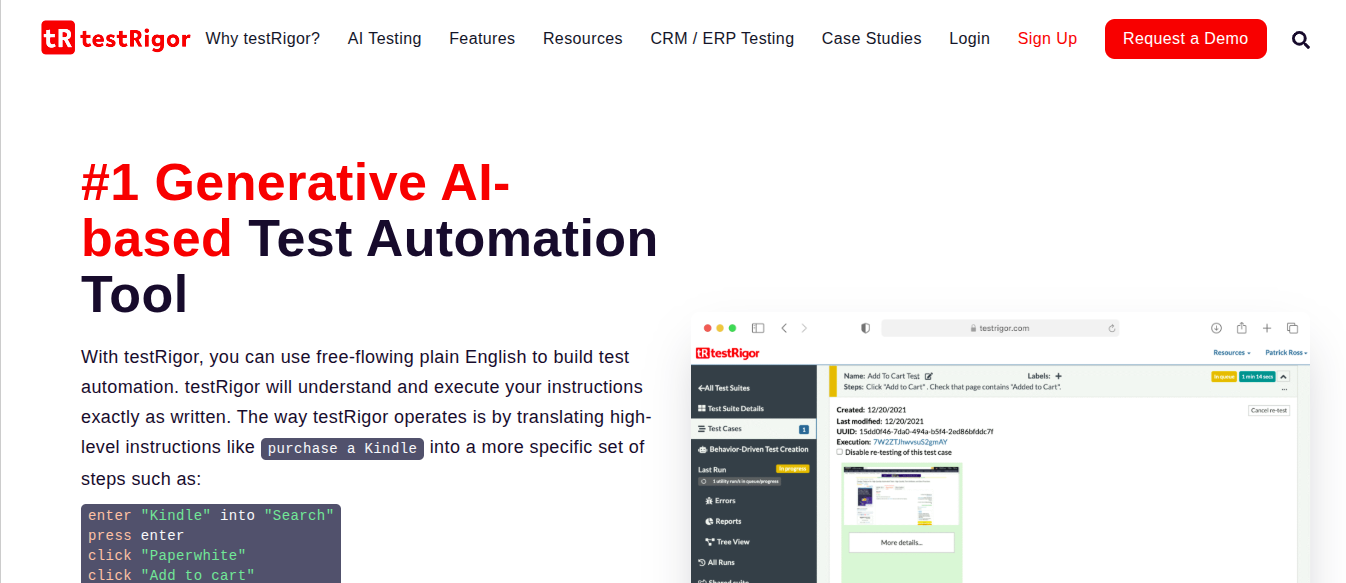
testRigor serves the audience Waldo served, and replaces recording with writing. Tests are plain English sentences covering web, mobile and API, running inside testRigor's own runtime, so there is no captured artifact to re-record after a redesign.
Device fidelity is the thing to check before committing, since the authoring layer matters less than whether the execution matches real hardware. A r/softwaretesting thread on emulation missing real iOS issues, at 23 votes, is the argument for confirming that first.
Email, SMS and API steps live inside the same flow, which covers the login and one-time-code paths that usually push a mobile team into custom hooks. For a team replacing a recorder, that breadth matters more than the authoring style.
A r/androiddev thread complaining that most Android tutorials and architecture guides skip automated testing entirely carries 190 votes and 98 comments, which is a fair picture of why codeless tools found an audience in the first place.
Pros: plain-English authoring with no recording, web, mobile and API in one flow, built-in CI integrations.
Cons: proprietary runtime with no open-source fallback, and a small ecosystem next to Appium or Playwright.
Pricing: published tiers.
Best for: non-technical authors who want the Waldo experience without the bundle.
Which part of Waldo are you replacing?
The standalone product. BrowserStack or LambdaTest, if what you valued was a tool with its own roadmap rather than a module inside a suite.
A free tier to start on. LambdaTest is the only option here with one, which matters if your evaluation has no budget attached yet.
The codeless recorder. testRigor if writing a sentence is close enough, Autosana if you would rather have no artifact at all, Kobiton if session capture into a script suits how your team works.
Mobile-only scope. LambdaTest, Autosana or testRigor each cover web and mobile in one place, which removes the second contract and the second set of results to reconcile before a release.
Devices on your premises. Kobiton, which is the only option here with a real on-premises story, and the only reason on this list to accept a heavier platform than the one you left.
Staying on Testim Mobile. Reasonable where you already run Tosca or qTest, since the platform integration is the benefit you are paying for.
Conclusion
Waldo did not fail. It was acquired, and the technology now ships as Testim Mobile inside a platform aimed at a larger buyer than the teams who originally adopted it.
That makes this an unusual alternatives decision, because the question is less about features than about fit. Teams who chose Waldo for a focused standalone tool will find that shape in BrowserStack, LambdaTest or Autosana. Teams who want the enterprise platform already have it, and switching away from it would cost them the integration they are paying for.
Frequently asked questions
What happened to Waldo mobile testing?
Tricentis acquired Waldo in July 2023. The waldo.com domain now 301-redirects to tricentis.com. The product ships as Tricentis Testim Mobile with the codeless recorder preserved, enterprise-tier pricing behind a request-pricing form, and no standalone Waldo brand or self-serve trial.
Is Tricentis Testim Mobile the same product as Waldo?
The core codeless recorder technology carried over, and so did a free trial, which the Testim Mobile page offers directly. What changed is the surrounding context: the standalone brand, its own domain and its own docs are gone, and the recorder now sits inside a Tricentis suite alongside Virtual Mobile Grid and Device Cloud. Teams who picked Waldo for its independence may find the platform a different fit.
What is the best free alternative to Waldo for mobile testing?
Playwright is the strongest free option for web E2E testing (Apache 2.0), but it does not do native mobile. For mobile, Appium remains the standard open-source framework. LambdaTest offers a free tier for cloud device testing. None replicate Waldo's no-code recorder out of the box.
Can Autosana replace Waldo for mobile testing?
Yes. Autosana covers iOS and Android with hosted real-device testing, plus web coverage Waldo never offered. The authoring model is intent-based rather than codeless recording, so there is no stored artifact to maintain. Per-agent-run pricing with a self-serve trial.
Does Waldo still have a free tier in 2026?
No public free tier exists on the Tricentis Testim Mobile product page. Pricing requires a request form and sales engagement.
Which Waldo alternative supports both web and mobile testing?
Autosana, BrowserStack, LambdaTest, and Sauce Labs each cover web and mobile. Autosana covers all three surfaces from one agent with intent-based authoring. BrowserStack, LambdaTest, and Sauce Labs provide device infrastructure where you bring your own test framework.
How long does migrating off Waldo take?
It scales with suite size and with how many recordings are still worth keeping, so scope it against your own flow count rather than a published average. Recorded tests rarely convert mechanically, so budget authoring time rather than conversion time.
Do any Waldo alternatives integrate with coding agents like Cursor or Claude Code?
Autosana ships an MCP server that lets coding agents invoke test runs end-to-end on every PR. Tricentis Testim Mobile does not document MCP or coding-agent integration. Most device clouds integrate with CI pipelines but not directly with coding agents.It scales with suite size and with how much of the suite still earns its keep, so scope it against your own flow count rather than a published average.